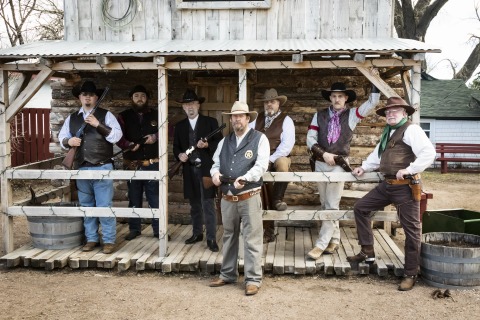
Cowboy
action shooters need good rifles. These have
to be lever actions that take pistol rounds. The rifles are shot
very quickly, so they have to be able to cope with that need, and
they require enough accuracy to be able to knock down roughly foot-square
steel plates at short to middle distances. A 25-yard shot would
be a long one at most events. There are occasional longer-range
tests that put a premium on accuracy, but for the most part, competitors
need a good, slick, handy lever rifle that works every time, and
keeps on working. Common calibers for Single Action Shooting Society
(SASS) cowboy events are .44-40, .45 LC, .38 Special, and occasionally
.38-40 and 44 Special. Lever rifles chambered for the .44 Special
usually also handle the .44 Magnum, which lets them serve as excellent
short-range hunting rifles for deer-size game. The .44 Mag provides
much more power than any of the other calibers mentioned except
the .45 LC with its most modern hot loads. We thought .44 Mag/Special
lever rifles might offer a whole lot of options that are sometimes
overlooked, so decided to look into them.
We acquired
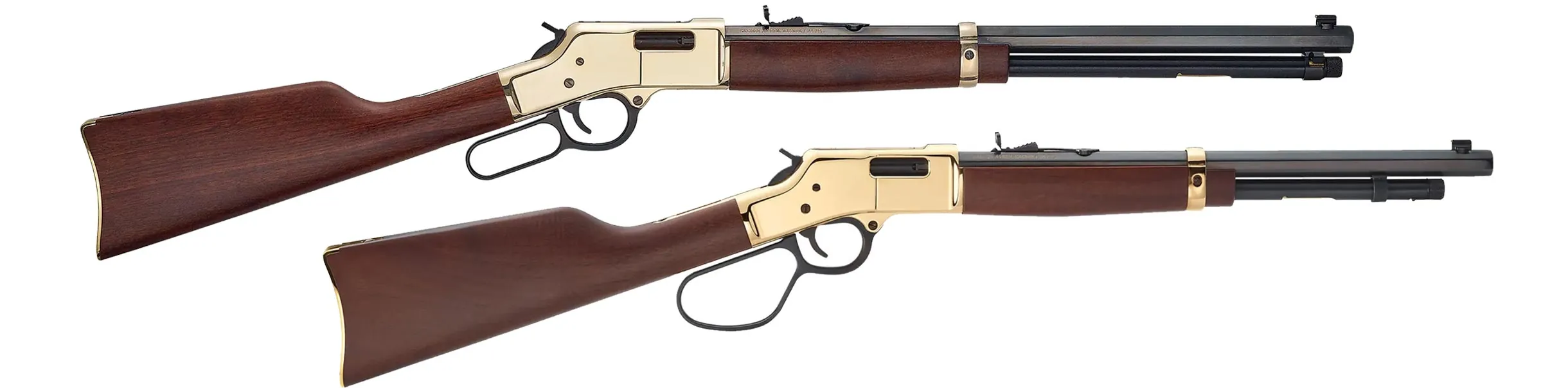
a couple of .44 Magnum/Specials, a Henry Big Boy ($775 MSRP) and
a Winchester Trail’s End Octagon ($757 MSRP), and
put them through our wringer. Here’s what we found.
Winchester
M94 Trail’s End Octagon, .44 Mag/Spl, $757
Blued steel and walnut are what you get
with the thoroughly traditional-looking
top-eject Winchester. The walnut was a big
cut above plain, but not as fancy as the
Henry’s.
The distinguishing features here were the crescent-shaped steel
butt plate and an octagonal barrel. There was a neat and nearly
invisible tang safety instead of the much-cursed crossbolt of older
Winchester lever rifles that seemed to do little but mess up the
action’s clean look. The new, unobtrusive, tang safety slide
was non-automatic, so it could be used or not, depending on the
preference of the shooter. Its location would prevent its accidental
use from casual bumps in the heat of action during a Cowboy event.
And there were more safety features. The hammer was rebounding,
though again there was no half-cock position. The hammer could only
fly all the way forward to strike the firing pin if the lever were
fully closed against a spring-loaded trigger block, and if the trigger
were fully pressed. The tang safety also prevented the hammer from
going all the way forward. There are several Trail’s End options,
and some can save lots of money if you don’t need or want
the crescent butt plate and octagonal
barrel. Check the company website
for details.
The inletting
of everything was very good, especially around the crescent butt
plate. We didn’t like the forend cap, which appeared
to be plastic. We thought it was thoroughly out of place on this rifle.
We liked the drilled and tapped holes for optional scope mount, but
the top ejection might make the choice of a scope and mounts something
of a problem. The sights were very much like the Henry’s but
with less of a buckhorn effect and with a smaller front bead. Both
units were dovetailed into the barrel, just as on the Henry. The Winchester’s
barrel was tapered, measuring 0.700 inch
at the muzzle and 0.840 inch at the breech,
which gave this rifle excellent balance and made it handier and much
lighter than the Henry.
The Winchester’s trigger had problems. There was a hitch just
before letoff that we found to be most disconcerting, especially when
firing the rifle rapidly. We would have to have that looked at before
using this gun in a match, we thought. The hitch made the shooter
think the trigger had broken, and then he’d stop pressing and
wonder why the rifle hadn’t fired. The hitch occurred at 2 pounds,
but final break came at 5 pounds, and was pretty clean. Another thing
we didn’t like was that the lever rattled at least a quarter
inch from side to side in the closed position. And one time the lever
bit one of our testers on the hand severely during rapid fire. By
comparison, the Henry’s lever moved less than a sixteenth of
an inch side to side, and we could not
get it to pinch our hand.
On the range,
we found loading was not as easy as with
the Henry. We had to force each cartridge into place, which was
thoroughly traditional and a thorough pain in the … fingers.
Loading the last cartridge required a rod
or another cartridge to force it forward enough so the door could
slam shut. Some of us have never liked this system, though it has
been in use since the Model 1873 came out.
The smallest
group the Winchester fired for us was just under 2 inches. Most
groups were in the 2.5 to 3-inch range, and these were three-shot
groups fired at 50 yards from a machine rest. The twist rate of
the Trail’s End was 1 turn in 26 inches, a faster rate than the
Henry’s barrel, and one that would seem to favor heavy bullets.
Yet we saw no such correlation in our limited
testing.Henry
Repeating Arms
Big Boy .44 Mag/Spl, $775
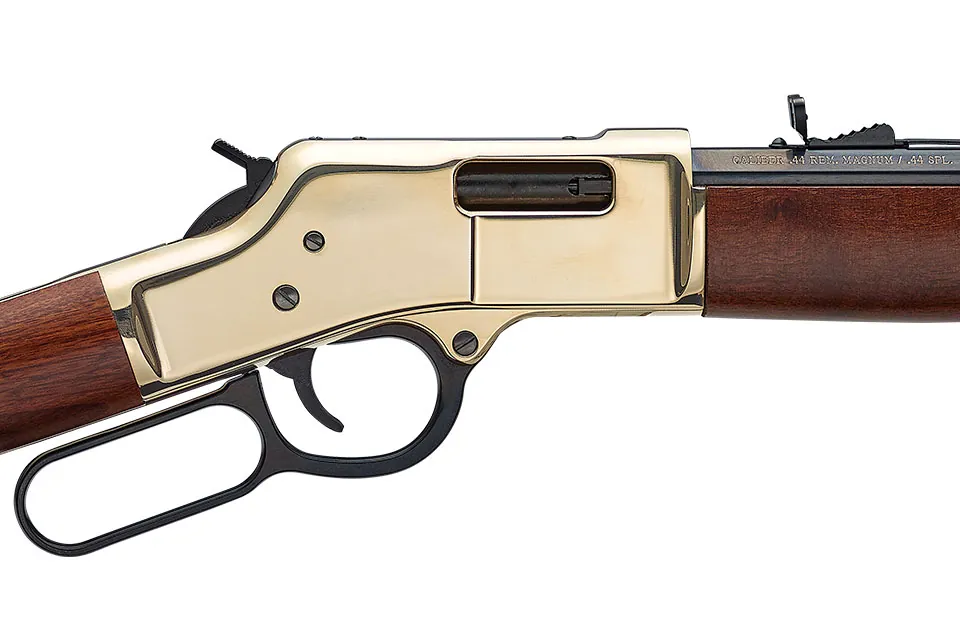
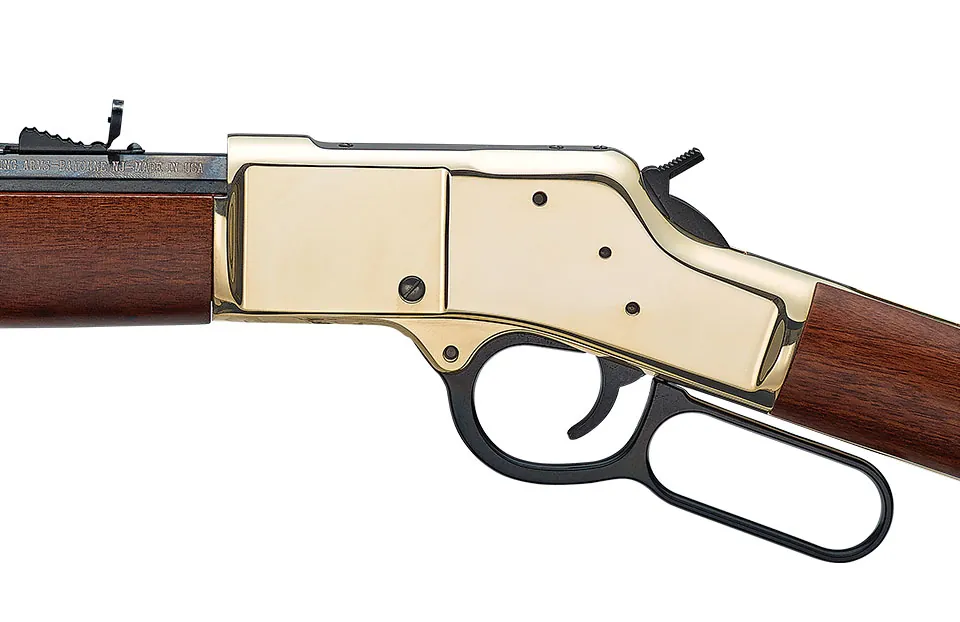
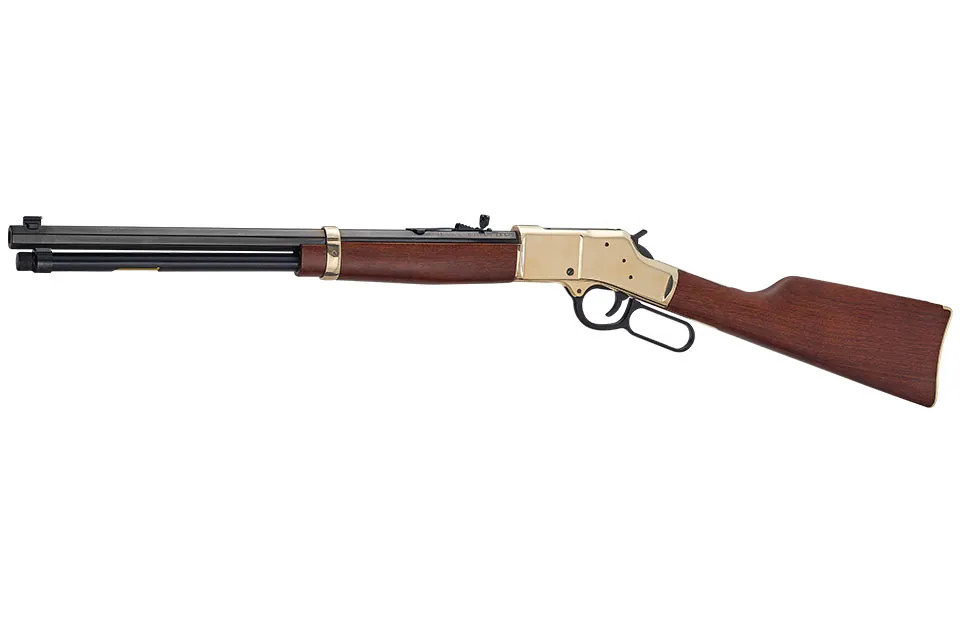
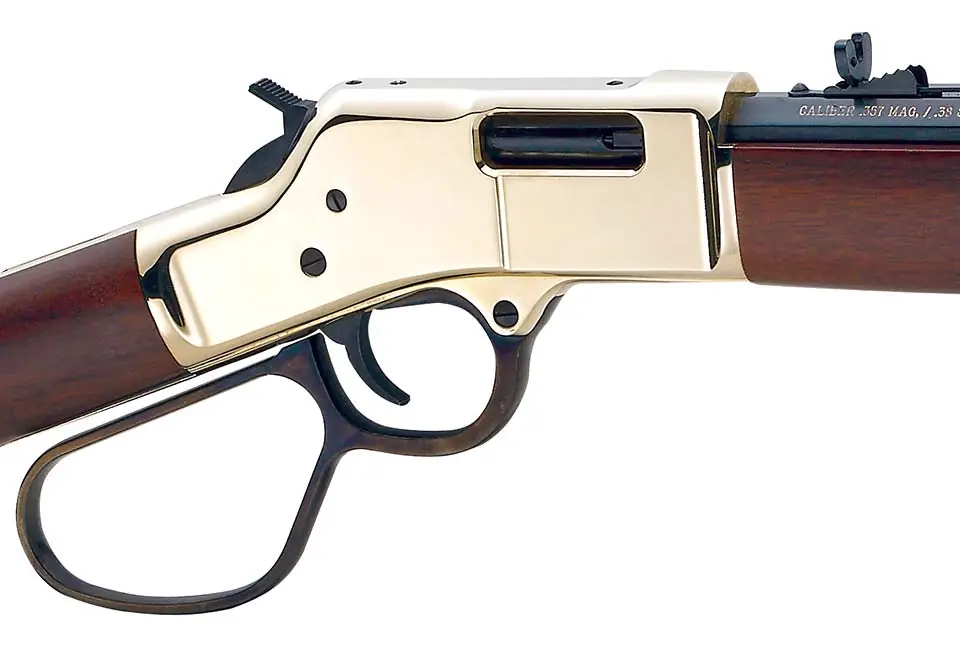
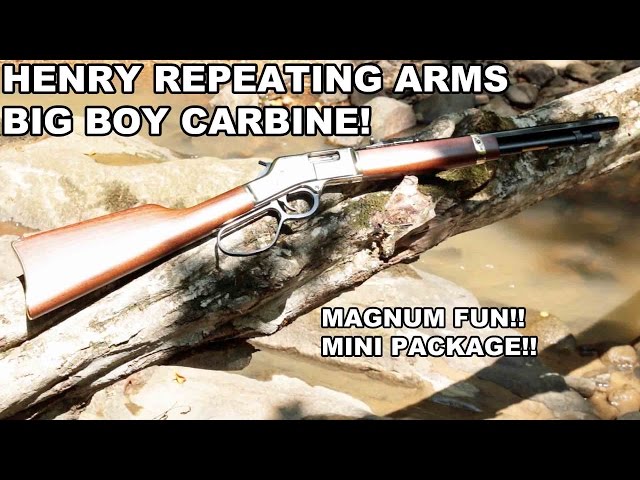
This was an attractive rifle right from
the get-go. The polished brass frame was
set off by excellent figured walnut and nice
bluing on the octagonal barrel. The barrel
band and butt plate were also brass. The company name and caliber
designations on the barrel were gold filled. Inletting was also excellent,
with the fine wood just slightly proud of the metal at action and
butt plate. The wood finish was complete, with no open pores and
with a glow to the wood that spelled a well-done oil finish. Yet
the wood finish was hard enough to thoroughly resist scratches and
dents, and we guess it is epoxy.
On opening the
rifle for the first time with its blued lever, we were struck by
how smooth it all was. The bolt was a round bar similar to that
found on Marlins. There was no obvious lever-lockout safety, but
the trigger could not be pulled unless the lever was fully home.
The hammer was either fully cocked or all the way down, no half-cock.
But there was a hidden trigger interlock that would prevent the
rifle’s
firing unless the trigger were fully depressed.
The
sights were traditional, a buckhorn rear
with a white diamond, the whole set into a spring-loaded ladder
assembly for elevation changes. Windage was by drifting either
the rear sight or the front, which was a large brass bead easily
seen. We found we had to drift the rear slightly to get centered.
More on the sights in a moment.
The tubular
magazine held ten .44 Mag rounds or eleven .44 Specials. Loading
was a snap. Twist the knurled steel end of the brass loading tube
and withdraw it until the loading port is fully exposed. Elevate
the muzzle slightly and drop in the required rounds. This should
be done with the action closed. Press the tube back into place
and give it a twist to lock it. We found this loading system to
be far easier than fighting the spring-loaded side plate of the
Winchester. Both rifles held the same amount of ammo.
The octagonal
barrel measured 0.830 inch across the flats,
and gave the rifle enough mass that recoil was simply not a consideration.
In fact, the only thing we could fault on this rifle was that it
was too heavy for its power, even with the hottest Buffalo Bore
loads. On the range we got excellent accuracy. We tested both rifles
with three types of .44 Mag loads, Buffalo Bore’s 270-grain JFN,
PMC’s 240-grain JHP, and Speer 250-grain Partition Gold. We
also tested both with Black Hills’ 210-grain FPL cast Cowboy
loads. Both rifles fed and fired them all
perfectly. We appreciated the smoothness
of the Henry during rapid-fire tests using
.44 Spl. loads. Both rifles worked well,
but we thought the Henry was a touch faster because it was slicker.
The
twist rate of the Henry was 1 turn in 38
inches, per the website info.
Perhaps that’s
why the Henry seemed to like most of our test
ammo. We had numerous three-shot groups with
all three shots touching at 50 yards, which
was a pleasant surprise. This rifle seemed to be full of the good stuff
that makes for a very special firearm. Its trigger broke at 4.5 pounds
with a touch of creep.
Gun
Tests Recommends
• Winchester M94 Trail’s End Octagon, .44 Mag/Spl, $757.
Don’t Buy. The trigger needed work, the accuracy was not great,
the action was nowhere near as slick as the Henry’s, and on
and on. With the Winchester we had a rifle that really didn’t
have a lot going for it other than its
good looks and fine balance.We note the
Winchester required a firm forward press on the lever to lift the
next round, just as lever Winchesters seem always to have needed,
though we can’t complain about that. The Winchester’s
metal polishing was superior to the Henry’s near the muzzle
on each flat of the eight-sided barrel. The Winchester’s steel
action might end up outlasting the mirror-polished brass frame of
the Henry, but it’d take thousands of rounds to find that out,
and we’d be happier shooting the Henry for those thousands of
rounds. The Winchester looked way more
traditional than the Henry, we thought. That might make it acceptable
to you, but we thought there were better ways to spend your money.
• Henry
Repeating Arms Big Boy .44 Mag/Spl, $775. Our Pick. We think any Cowboy
Action competitor would be pleased to have this rifle. An ideal companion
to a brace of .44 Special handguns, this brass-framed rifle will catch
many eyes and compliment any Old West clothes the shooter wears. There
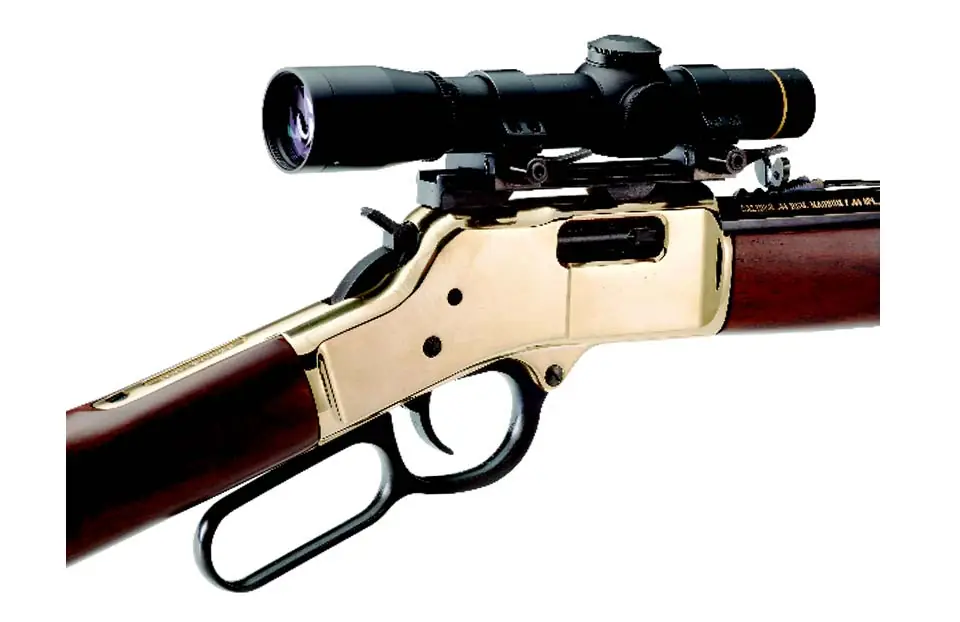
were no predrilled holes to mount a scope, so if you want to go hunting
with this rig you’ll have
to either use the iron sights or mess up the polished brass by drilling
it. Its side ejection would make a scope right at home, but we’d
personally never scope this handsome rifle. A tang-mounted aperture
would be the ticket to better field use, we thought. We initially
had trouble getting the rifle to print low enough with the light .44
Special loads, but then we noticed the rear sight’s inset blade
was itself adjustable, and it could also
be reversed to give a V notch instead of
the U, which was another pleasant surprise.
« Back
to Henry Big Boy rifle description
|